

Dental implant surgery
Dr. Dt. Kıvanç Türkoğlu, Specialist in Oral and Maxillofacial Surgery · Klinik 29, Altunizade, Üsküdar
03/ 10
Summary
- An implant is a small screw that replaces the root of a missing tooth and is placed in the jawbone. Once it bonds with the bone, a crown, bridge or denture is attached.
- Suitability depends on bone volume and quality, gum health and general health. Some conditions and medicines call for extra assessment.
- The plan starts from the tooth that will sit on top. The position, length and angle of the implant are chosen to suit that tooth.
What are the parts of an implant?
Treatment involves three main parts. The body that sits in the bone is usually made of titanium or a titanium alloy, and less often of zirconia. The connecting part that brings it into the mouth is called the abutment. The visible part on top is the crown, bridge or denture.
The surface of the body is roughened by special processes, which helps bone cells attach. Its length and width are chosen according to the bone and the tooth it will carry.
How does it bond with the bone?
After placement, the surrounding bone remodels towards the implant surface. This process is called osseointegration. A bonded implant sits firmly in the bone and passes chewing forces to it.
Bonding begins in the first weeks and usually takes a few months to complete. The implant should not be overloaded during this time. Avoiding hard food on that side and attending check-ups protect healing.
Who needs extra assessment?
If the jaw is still growing, treatment waits until growth is complete. If diabetes is poorly controlled, blood sugar may need to be brought under control first. Radiotherapy to the head and neck can reduce the bone's ability to heal, so timing and method are planned together with the relevant doctor.
Some medicines that slow bone turnover, such as bisphosphonates, can cause healing problems in the jawbone. The risk depends on the medicine, dose, duration of use and the condition it was prescribed for. Tell your clinician if you have ever taken one of these medicines.
Smoking harms the tissues around implants and raises the risk of implant loss. Active gum disease is treated first. People with a history of gum disease can also receive implants, but regular care and check-ups become even more important for them.
How many implants, which prosthesis?
A single missing tooth is replaced with a crown on one implant. When several neighbouring teeth are missing, a bridge on fewer implants may be planned.
For a jaw without teeth there are fixed options and removable dentures that clip onto implants. The choice is made together, based on bone volume, cleaning habits and expectations. For a fixed full bridge on a small number of implants, see All-on-4 and All-on-6.
When bone is lacking
After a tooth is removed, the jawbone gradually becomes thinner and shorter. If there is not enough width or height to surround an implant, there are several routes.
Missing bone can be rebuilt with bone grafting, sometimes in the same session as the implant and sometimes as a separate step. At the back of the upper jaw the sinus floor can be raised (sinus surgery). In some cases shorter or narrower implants can reduce the need for extra surgery.
When bone loss in the upper jaw is severe, zygomatic implants anchored in the cheekbone are among the options. The right route is discussed after measurements on a CT scan.
Digital planning and surgical guides
After the examination and a panoramic X-ray, a cone beam CT is usually requested. The nerve canal in the lower jaw and the sinus and nasal floor in the upper jaw are measured.
The CT can be merged with an intraoral scan on a computer. The future tooth is designed on screen first, and the implant position is chosen to suit it. When needed, a surgical guide made from this plan and seated on the teeth or gums is used. It helps place the implant at the planned position and angle. Careful examination and surgical experience are still required.
The surgical stage
The procedure is usually done under local anaesthesia. Sedation may be an option for anxious patients or longer procedures. The gum is lifted, a site matching the implant size is prepared in the bone and the implant is placed.
In some cases the work is done through a small opening without lifting the gum. This depends on the bone and gum condition.
Same-day implants and immediate loading
Placing an implant in the same session as an extraction is called immediate placement. It requires no active infection, socket walls that are sound enough and an implant that is held firmly in the bone. Otherwise the socket is left to heal for a few weeks or a few months.
Attaching a tooth that meets the opposing teeth within the first week is called immediate loading. If the temporary tooth is kept out of contact with the opposing teeth, it is called immediate restoration. In both cases the key measure is how stable the implant is at the moment it is placed. If stability is low or there is a strong clenching habit, the implant is usually left to heal without load.
How long does treatment take?
The total time depends on when the tooth was removed, whether extra bone work is needed and which jaw is involved. Without extra procedures, a few months usually pass between implant placement and the final tooth. It is often longer in the upper jaw.
Grafting or sinus surgery adds healing time. Your own timeline is discussed after the examination and scan.
Care and check-ups
The implant itself cannot decay, but the gum and bone around it can become diseased. Inflammation limited to the gum is called peri-implant mucositis. It shows as bleeding and redness and can be treated early. If inflammation reaches the bone, peri-implantitis develops and bone is lost around the implant.
Daily brushing, interdental brushes or floss and check-ups at the intervals your clinician recommends lower this risk. Check-ups examine the tissue around the implant and include X-rays when needed.
Known risks
Swelling, bruising and tenderness can occur early on. If an implant does not bond with the bone, it is removed and the site is reassessed after healing.
Altered sensation near the nerve in the lower jaw and sinus problems in the upper jaw can occur, though rarely. Over time a prosthetic screw may loosen or a crown may chip.
Videos
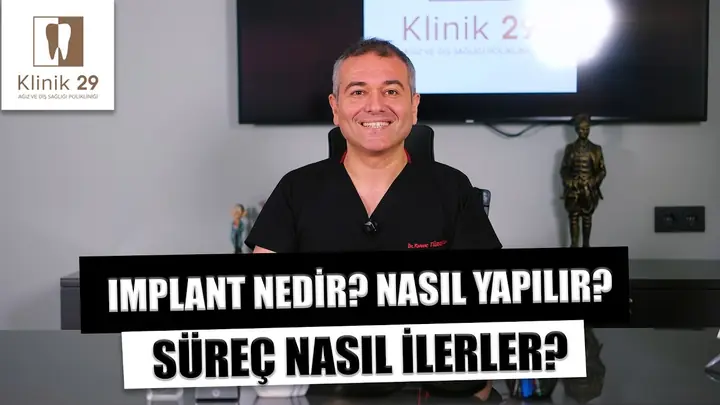
What is an implant and what are the stages of treatment?
Open the video page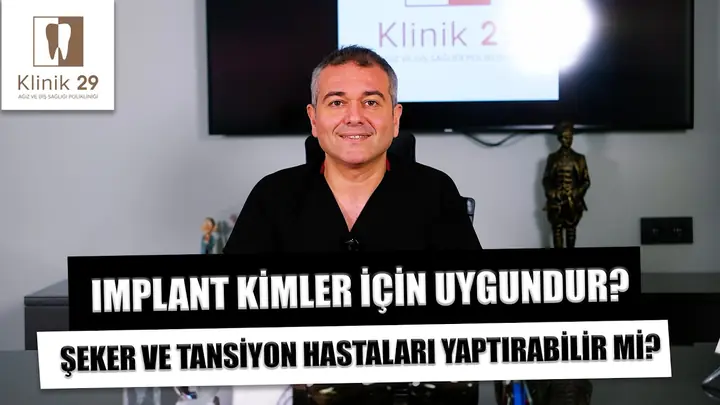
Who are implants suitable for?
Open the video page
How are implant types chosen?
Open the video page
What is considered when choosing an implant?
Open the video page
Care after implant treatment
Open the video page
Videos in Turkish from the Klinik 29 YouTube channel. Pressing play opens the YouTube player on this page.
Frequently asked
This information does not replace an examination and diagnosis. The diagnosis and treatment plan become clear after the examination and may change.
Does an implant hurt?
I numb the area with local anaesthesia. Once the numbness is adequate, pain is not expected during the procedure, but you may feel pressure and vibration. If you feel pain, tell me and I will reassess the anaesthesia. When the numbness wears off, there may be tenderness, swelling and bruising for a few days.
How many sessions does treatment take?
In most cases I place the implant in a single surgical session. The implant then needs time to bond with the bone. Check-ups and the prosthetic stage need separate appointments, and some patients need a second minor procedure to uncover the implant. The total time depends on the bone and on the placement and loading method.
What happens if there is not enough bone?
After an extraction, the jawbone gradually becomes thinner and shorter. If there is not enough bone, it can be rebuilt with a graft, and at the back of the upper jaw the sinus floor can be raised. In selected patients with severe bone loss in the upper jaw, a zygomatic implant anchored in the cheekbone may be considered. I decide by looking at the examination, the CT scan, sinus health and the prosthetic plan together.
Does each missing tooth need its own implant?
Not always. A single missing tooth is replaced with one implant and a crown on top. If several neighbouring teeth are missing, a bridge on fewer implants may be planned. In a jaw without teeth, the number of implants and the type of prosthesis are decided together, based on bone volume, your cleaning habits and your expectations.
When can I go back to work after an implant?
With a single implant, many people go back to work within a day or two. I will ask you to put off heavy exercise and strenuous work for the first few days. In the first days, eat lukewarm, soft food and do not chew hard food on the surgical site. If there are several implants or a bone procedure, this period may be longer.
I have diabetes or take a medicine. Can I have an implant?
Some conditions and medicines call for extra assessment. If you have diabetes, I want your blood sugar to be under control. With bone medicines such as bisphosphonates or denosumab, the risk depends on why the medicine is used, the dose and how long it has been taken, and an implant may not be suitable for some patients. Tell me about medicines you have taken in the past as well, and do not stop your medicine on your own.
What happens if the implant does not bond with the bone?
This can happen. I remove an implant that has not bonded and reassess the site once it has healed. If suitable, a new implant is planned. I explain the risks separately at the examination before the procedure.
How do I care for an implant, and how often should I come for check-ups?
The implant itself cannot decay, but the gum and bone around it can become diseased. Daily brushing and interdental brushes or floss reduce this risk. I set the check-up interval according to your gum health, how well you clean and your risks, and some patients need more frequent check-ups. If you notice bleeding or redness of the gum, do not wait for your next check-up.
I smoke. Will it affect my implant?
Smoking slows healing and raises the risk of gum and bone problems around the implant. I advise you to stop before and after the procedure. In the long term, quitting also matters for the care of the implant.
Will an implant last a lifetime?
No such period can be given. Cleaning habits, smoking, gum health and regular check-ups all affect how long an implant stays in place.
Can an implant be placed on the day of extraction?
Sometimes. If there is no infection and the bone holds the implant firmly, it can be placed in the same session. Otherwise healing comes first.
I am older. Can I still have implants?
General health and bone condition matter more than age. Both are assessed at the examination.
I smoke. Can I have implants?
Implants can be placed in smokers. However, smoking raises the risk of implant loss and inflammation around implants. Stopping before and after surgery, and quitting if possible, is advised.
Can I have an MRI scan with implants?
Titanium and zirconia implants are not magnetic and in most cases do not prevent an MRI scan. The image may be distorted near the implant. Tell the radiology team about your implants and any magnetic denture attachments before the scan. They decide on suitability based on the components. Bring your implant card if you have one.
I have gum disease. Can I have implants?
Gum disease is treated and brought under control first. People with a history of gum disease have a higher risk of inflammation around implants, so regular care and check-ups are important.
Sources
- Buser D, Sennerby L, De Bruyn H. Modern implant dentistry based on osseointegration: 50 years of progress, current trends and open questions. Periodontol 2000. 2017;73(1):7-21. doi.org/10.1111/prd.12185
- Berglundh T, Armitage G, Araujo MG, et al. Peri-implant diseases and conditions: Consensus report of workgroup 4 of the 2017 World Workshop. J Clin Periodontol. 2018;45 Suppl 20:S286-S291. doi.org/10.1111/jcpe.12957
- Gallucci GO, Hamilton A, Zhou W, Buser D, Chen S. Implant placement and loading protocols in partially edentulous patients: A systematic review. Clin Oral Implants Res. 2018;29 Suppl 16:106-134. doi.org/10.1111/clr.13276
- Buser D, Chappuis V, Belser UC, Chen S. Implant placement post extraction in esthetic single tooth sites: when immediate, when early, when late? Periodontol 2000. 2017;73(1):84-102. doi.org/10.1111/prd.12170
- Ruggiero SL, Dodson TB, Aghaloo T, Carlson ER, Ward BB, Kademani D. American Association of Oral and Maxillofacial Surgeons' Position Paper on Medication-Related Osteonecrosis of the Jaws: 2022 Update. J Oral Maxillofac Surg. 2022;80(5):920-943. doi.org/10.1016/j.joms.2022.02.008
- Chrcanovic BR, Albrektsson T, Wennerberg A. Smoking and dental implants: A systematic review and meta-analysis. J Dent. 2015;43(5):487-498. doi.org/10.1016/j.jdent.2015.03.003
- Smeets R, Schöllchen M, Gauer T, et al. Artefacts in multimodal imaging of titanium, zirconium and binary titanium-zirconium alloy dental implants: an in vitro study. Dentomaxillofac Radiol. 2017;46(2):20160267. doi.org/10.1259/dmfr.20160267
- Bornstein MM, Horner K, Jacobs R. Use of cone beam computed tomography in implant dentistry: current concepts, indications and limitations for clinical practice and research. Periodontol 2000. 2017;73(1):51-72. doi.org/10.1111/prd.12161
This treatment is carried out at Klinik 29 (Altunizade, Üsküdar). Klinik 29 website (English)
This information is for general guidance and does not replace an examination. Rapidly spreading facial swelling or difficulty swallowing or breathing is an emergency. Go to a hospital emergency department.

Last updated: