
Orthognathic surgery
Dr. Dt. Kıvanç Türkoğlu, Specialist in Oral and Maxillofacial Surgery · Klinik 29, Altunizade, Üsküdar
09/ 10
Summary
- Orthognathic surgery corrects position problems of the upper or lower jaw that come from the skeleton.
- It is considered when the jaws sit too far forward or back relative to each other, the teeth do not meet and facial balance is affected.
- Treatment is carried out together with an orthodontist. Most patients need orthodontics before and after surgery.
When is it considered?
Examples are a Class III bite with the lower jaw forward, a Class II bite with it set back, an open bite where the front teeth do not touch, and marked facial asymmetry. Chewing and speech difficulties may accompany them.
If the problem comes only from tooth alignment, orthodontics is usually enough. The examination and records make this distinction.
How is the plan built?
The orthodontist first aligns the teeth to suit the new jaw position. This preparation usually takes months.
Before surgery, facial photographs, a cephalometric X-ray and, if needed, a 3D scan are taken. The planned jaw movements are measured on these records and guides for surgery are prepared.
The operation
Surgery is done under general anaesthesia in a hospital. Most incisions are inside the mouth.
Le Fort I osteotomy of the upper jaw and bilateral sagittal split osteotomy of the lower jaw are common techniques. The bones are fixed in their new position with small titanium plates and screws.
Recovery
Marked facial swelling appears in the first days, and most of it settles within a few weeks. A liquid and soft diet is followed early on.
After surgery, orthodontics continues until the teeth settle in the new position.
Known risks
Reduced feeling in the lower lip and chin is common. It usually improves over months but can be permanent in some patients.
Infection, bleeding, later removal of plates and screws and some shift of the jaw towards its old position are also known risks.
Academic work in this field
Dr. Dt. Kıvanç Türkoğlu's doctoral thesis evaluated hard and soft tissue changes after orthognathic surgery in Class III patients (Ankara University Institute of Health Sciences, 2011, YÖK thesis no. 281436).
Videos
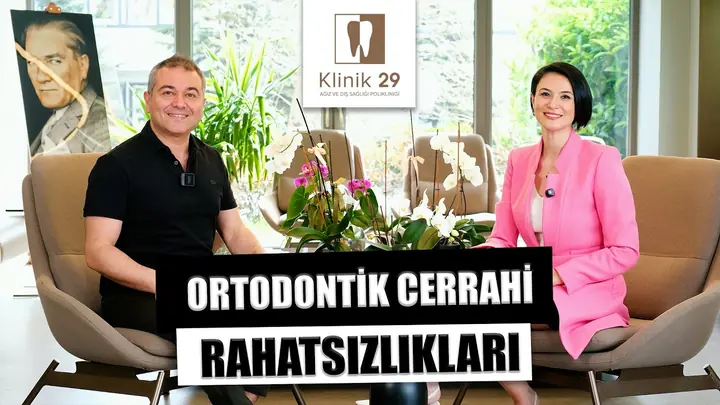
What is orthodontic jaw surgery and when is it needed?
Open the video page
Orthodontic jaw surgery: how does the process go?
Videos in Turkish from the Klinik 29 YouTube channel. Pressing play opens the YouTube player on this page.
Frequently asked
Does the operation leave facial scars?
Most incisions are inside the mouth, so a visible facial scar is usually not left.
How long is the hospital stay?
It depends on the extent of surgery and recovery. It is usually a few days.
Why does orthodontics start before surgery?
The teeth need to be aligned to fit the new jaw position. The sequence is decided with the orthodontist for each patient.
Sources
- Posnick JC. Orthognathic Surgery: Principles & Practice. St. Louis: Elsevier Saunders; 2014.
- Türkoğlu K. Sınıf III hastalarda ortognatik cerrahi sonrası sert ve yumuşak doku değişikliklerinin değerlendirilmesi [Doktora tezi]. Ankara Üniversitesi Sağlık Bilimleri Enstitüsü; 2011. YÖK Tez No 281436. tez.yok.gov.tr/UlusalTezMerkezi/
Examination and treatment planning take place at Klinik 29 (Altunizade, Üsküdar). Klinik 29 website (English)
This information is for general guidance and does not replace an examination. Rapidly spreading facial swelling or difficulty swallowing or breathing is an emergency. Go to a hospital emergency department.

Last updated: